Social Media•
on October 13th, 2009•
(Kansas City, Missouri) – Entrepreneurship, networking and the opportunity to collaborate will be three areas of focus for the second annual Highlight Midwest, scheduled for October 23, 2009 in Des Moines, Iowa. Over 200 participants are expected for the conference. Drawing from the four states of Kansas, Missouri, Iowa and Nebraska, this barcamp-themed meeting will feature some of the most innovative companies in the midwest demonstrating new applications and talking about technology and startups outside of the east and west coasts. Simon Kuo, Ph.D., CEO of LightThread, LLC, a Kansas City-Crossroads area strategy, social media and web development company is scheduled to deliver one of three keynote addresses at the conference.
“This meeting is one of the best I’ve attended as far as meeting other entrepreneurs in a setting that encourages future collaboration.” said Dr. Kuo, “When starting a new business one of your greatest assets will be the partnerships you create with similarly-minded people. I really valued the ideas that were generated from last year’s sessions and I’m looking forward to this year’s event.”
Other companies featured in the day long conference include Dwolla, a web application that allows users to send and receive money, graffititracker, a system to track graffiti for law enforcement and whatthehashtag, the online wiki for Twitter hashtags. Mike Draper, a longtime Iowa-based small business and startup advocate will be another featured speaker.
About LightThread – LightThread, LLC, established in 2008, is a next generation strategy, interactive services and web development firm specializing in optimizing business performance and brand. Through the use of strategy, social media, technology and integrated marketing development, LightThread assists businesses in reaching the next level. For more information about LightThread, LLC please visit: http://www.lightthread.com
Contact: Lisa Qualls (816) 298-9913. email: lisa@lightthread.com
###

The biggest tech news today was the release of Google Wave to 100,000 beta testers. Because of the limited number of invitations, the usual outrageous behavior by members of the tech community ensued. At one point sources reported that an invitation was being offered on eBay for $5100 dollars. After many of these outlandishly priced offers were pulled, remaining invites were being hawked for a more reasonable $70 to $100 dollars. Similarly Twitter users who tweeted about receiving Wave invitations were flooded with requests from users begging for invitations. At the LightThread office we were lucky enough to have received our invitation at 12:32 a.m. yesterday morning and we wasted no time in trying it out.
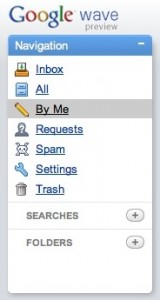 When one logs into Wave the very first time, one is greeted with several messages created by the Wave team. Cleverly they actually use Wave to illustrate how it can be used. How’s that for a recursive demonstration?
Though initial reviews highlighted the less-than-enthusiastic response from certain high-profile tech geeks, the usefulness of Wave and its interface design are most apparent when more than one person is using it. It was immediately apparent to us that Wave solves a few of the most obvious issues with the Twitter interface: conversations that are totally sequential yet threaded at the same time. In other words, Twitter’s interface only presents tweets as they occur. Streams of conversations between various people that are threaded have the tendency to become lost in the relentless wash of tweets from everyone else. Google Wave solves that problem by allowing replies to anyone anywhere in the stream of messages. Thus one can have multiple simultaneous real-time conversations with a number of people without losing the thread of any of the simultaneous conversations. Without a doubt this takes a little getting used to–many people aren’t naturally adept at tracking more than one simultaneous conversation–after all how often does this really happen during a verbal discussion? I’m certain however, that people will quickly adapt to this paradigm. Making it easier is the fact that the conversations don’t simply fade into the ether–they persist on the page. The Google Wave team has also incorporated a handy feature–the ability to “play” the wave, step-by-step to catch anything that might have been missed when it occurred in real-time.

As reported previously, the application also allows those participating in a wave to insert videos, graphics and other files. The inclusion of rich media makes this more than simply a many-to-many text messaging application. In addition, gadgets are also supported by Wave. This enables the platform to be extended in ways that will increase its usefulness. Included in the Wave beta are a mapping gadget and an yes/no/maybe gadget. These are both used in demonstrations to highlight their usefulness for tasks like making group plans and planning trips, respectively.
Ultimately, like many new tools and applications, we’ll have a much better understanding of Google Wave and its usefulness after it has been tested by the initial group of users. The LightThread team is looking forward to using Google Wave in our day-to-day activities and we’ll be eagerly reading others’ impressions of the platform in upcoming weeks. We’ll report back to you as our testing continues. In the meantime, if you’re also on the platform, start a wave with us!!